




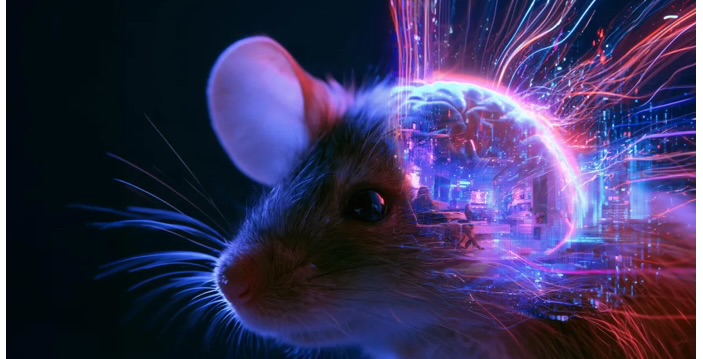
科学家们根据老鼠大脑的活动重新构建了视频,从而让我们得以一窥大脑是如何将视觉信息转化为感知的。图片来源:AI/ScienceDaily.com
Scientists have reconstructed short videos using only brain activity recorded from mice, effectively allowing researchers to recreate what the animals were seeing. The study, led by researchers at University College London (UCL), offers a new way to investigate how the brain transforms visual input into an internal representation of the world.
科学家们仅利用从老鼠大脑中记录下来的活动数据,就成功重建了短小的视频片段。这样一来,研究人员就能再现这些老鼠所看到的景象。这项由伦敦大学学院的研究人员主导的研究,为了解大脑如何将视觉信息转化为对世界的内部表征提供了新的途径。
Published in eLife, the findings could help scientists better understand how visual information is processed in the brain and may eventually make it possible to compare how different species perceive the same surroundings.
这项研究发表在《eLife》杂志上。其研究成果有助于科学家们更深入地了解大脑是如何处理视觉信息的。最终,这一研究或许还能让我们比较不同物种是如何感知同一周围环境的。
Decoding What the Brain Sees
解读大脑所“看见”的事物
Researchers have spent years trying to understand how the brain interprets signals arriving from the eyes. In human studies, scientists have shown people images and movies while recording brain activity with fMRI, then used those measurements to try to reconstruct visual information down to the level of individual pixels.
研究人员多年来一直致力于研究大脑是如何解读来自眼睛的信号的。在人类实验中,科学家们向受试者展示各种图像和视频,同时利用功能性磁共振成像技术记录大脑的活动情况。然后,他们利用这些数据来尝试重建视觉信息,甚至精确到单个像素的水平。
The new work takes a different approach. Instead of relying on broader brain imaging signals, the researchers used recordings from individual brain cells in mice. These single-cell measurements can provide a more detailed picture of how visual information is represented in the brain.
这项新研究采用了不同的方法。研究人员没有依赖大脑的整体成像信号,而是利用了来自小鼠单个脑细胞的信号。通过这种单细胞测量方式,我们可以更详细地了解视觉信息在大脑中的处理方式。
Using activity recorded from the visual cortex, the team was able to generate high-quality reconstructions of videos that had been shown to the mice.
通过分析来自视觉皮层的活动数据,该团队成功重建了那些被展示给老鼠的视频内容,重建效果非常出色。
Lead author Dr. Joel Bauer (Sainsbury Wellcome Centre at UCL) said: “We wanted to have a better way of investigating how the brain interprets what we see. The current methods of understanding what specific groups of neurons are representing are not very generalizable to situations which haven’t been specifically tested for. And so, we wanted to develop a method that can capture what is being represented in the brain and compare that to reality.”
该研究的主要作者、伦敦大学学院 Sainsbury Wellcome 中心的 Joel Bauer 博士说:“我们希望找到一种更有效的方法来研究大脑是如何解读我们所看到的事物的。目前,我们用来了解哪些神经元群体负责处理特定信息的手段,很难被推广到那些未经专门测试的情况中。因此,我们希望开发出一种能够准确反映大脑中信息处理情况的方法,并将其与现实情况相对照。”
The researchers are especially interested in the differences between what is physically present in front of an animal and how that information is represented inside the brain. Studying those differences could reveal which visual features the brain emphasizes, changes, or filters out.
研究人员特别感兴趣的是:动物眼前实际存在的视觉信息与大脑中对该信息的处理方式之间的差异。通过研究这些差异,我们可以了解大脑会强调、修改或忽略哪些视觉特征。
Turning Neuron Activity Into Video
将神经元活动转化为视频图像
To reconstruct the movies, Dr. Bauer and his colleagues used a dynamic neural encoding model originally developed by another research team for the 2023 Sensorium Competition. The model is designed to predict how individual neurons (brain cells) will respond while mice watch movies. It also takes into account other factors, including the animals’ movements and changes in pupil diameter.
为了重建这些视频,鲍尔博士和他的同事们使用了另一个研究团队为 2023 年 Sensorium 竞赛而开发的动态神经编码模型。该模型旨在预测老鼠在观看视频时,各个神经元会如何反应。此外,该模型还考虑了其他因素,比如老鼠的肢体动作以及瞳孔大小的变化。
The UCL researchers then refined the approach using the same dataset. First, they calculated how the neurons were predicted to behave if the mouse had been looking at a blank screen. They compared that prediction with the neurons’ actual activity while the mouse watched a movie.
UCL 的研究人员随后使用相同的数据集对这一方法进行了进一步优化。首先,他们计算了当老鼠注视着空白屏幕时,神经元的预期反应。接着,他们将这一预测结果与老鼠观看电影时的实际神经元活动情况进行了比较。
The neural activity had been measured with a microscopic imaging method that identifies which individual brain cells are active by detecting localized increases in calcium levels.
神经活动的测量是通过一种显微成像技术来实现的。该技术通过检测大脑中各個神经细胞处的钙水平变化,从而确定哪些神经细胞处于活跃状态。
Using the difference between predicted and measured activity, an algorithm gradually changed the pixels of an initially blank movie. With each adjustment, the reconstructed video became more similar to the one that had actually been shown to the mouse.
通过比较预测值与实际测量值之间的差异,该算法逐步修改了最初为空白的视频画面。随着每次调整,重建出的视频就越来越接近于实际展示给老鼠的视频内容。
Reconstructing a New 10-Second Movie
重新制作一段 10 秒长的新视频
After the model had been trained, the researchers gave it a more difficult test. They recorded a mouse’s brain activity while it watched a video that had never been included in the model’s training data.
在模型训练完成后,研究人员对其进行了更复杂的测试。他们记录了老鼠在观看那些从未被纳入模型训练数据中的视频时的大脑活动情况。
Using only that neural activity, the system reconstructed a 10-second movie resembling the unseen video.
仅利用那些神经活动,该系统就重建出了一段长达 10 秒的视频,这段视频与原本未看到的视频极为相似。
Dr. Bauer added: “Using this approach, we were able to achieve high-quality reconstructions of 10-second video clips. The accuracy of the reconstructions improved with the inclusion of data from more individual neurons, demonstrating the importance of comprehensive neural data.”
鲍尔博士补充说:“通过这种方法,我们成功重建了 10 秒长的视频片段。随着纳入更多单个神经元的数据,重建的准确性也有所提高。这充分体现了全面收集神经数据的重要性。”
The result suggests that the method was not simply memorizing previously shown videos. Instead, it was able to use patterns of neural activity to infer visual information from a new scene.
研究结果表明,该方法并非单纯地重复记忆之前看过的视频内容。相反,它能够利用神经活动的模式,从新场景中推断出视觉信息。
Measuring How Closely the Videos Matched
衡量视频之间的相似程度
To evaluate the reconstructions, the researchers used a method called pixel correlation, which compares corresponding pixels in the original and reconstructed movies.
为了评估这些重建结果,研究人员采用了一种名为“像素相关性”的分析方法。该方法通过比较原始图像与重建图像中对应的像素来评估重建效果。
The analysis showed only small differences in the timing of the two videos. However, the researchers say there is still considerable room to improve image resolution and the amount of the visual scene that can be reconstructed.
分析结果显示,这两个视频在时间上的差异很小。不过,研究人员指出,目前在图像分辨率以及能够重建的视觉场景范围方面,仍有很大的提升空间。
Future work will focus on collecting data that can support sharper reconstructions and cover a larger portion of what the animals are seeing.
未来的工作将致力于收集更多数据,以便能够更精确地再现动物所看到的景象,并涵盖更广的范围。
Why Our Brains Do Not Simply Record Reality
为什么我们的大脑不会简单地记录现实而已
The researchers now plan to use the technique to investigate a deeper question about vision: how much does the brain’s internal representation differ from the world that is actually in front of us?
研究人员现在计划利用这项技术来探讨一个更深入的视觉相关问题:大脑内部的表征与我们眼前所看到的现实世界之间,究竟存在多大的差异?
Vision is not simply a camera-like recording process. The brain continuously interprets, filters, and modifies incoming sensory information. Understanding exactly where and how those changes happen could reveal important principles about perception.
视觉并非仅仅是类似相机的简单记录过程。大脑会持续不断地解读、筛选和调整接收到的感官信息。弄清楚这些变化究竟发生在何处、以何种方式发生,有助于我们理解与感知相关的重要原理。
Dr. Bauer concluded: “We don’t have a perfect representation of the world in our heads. The visual processing pipeline skews and warps our representation in a way that modifies information. This deviation between reality and representations in the brain is not necessarily an error but a feature, reflecting how our minds interpret and augment sensory information. We want to explore how this happens in the brain.”
鲍尔博士总结道:“我们大脑中对世界的认知并不完美。视觉处理过程会以某种方式扭曲和改变我们对世界的认知。这种现实与大脑所呈现的图像之间的差异并非错误,而是一种正常现象,它反映了我们大脑如何解读和加工感官信息。我们希望探索大脑中究竟是如何实现这一过程的。”









暂无评论内容